
Annuities
Are Bonds Safe? 8 Bond Risks Retirees Should Know
THE PROBLEM
Bonds Carry A Significant Amount of Risks
Most investors know that stocks can lose value. What they don’t realize is that bonds — the so-called “safe” part of a retirement portfolio — carry their own set of serious risks that can quietly erode decades of savings.
Unlike stocks, where risks are visible and well-understood, bond risks are subtle and often ignored until it’s too late. Inflation slowly eats away at fixed coupon payments year after year. Reinvestment risk locks you into below-market income when rates change. Annual tax obligations silently drag on compounding. And for corporate and municipal bonds, default risk is always present regardless of credit ratings.
The 2022 bond market was a stark reminder — but that was bond fund risk. Even investors who hold individual bonds directly to maturity face real, ongoing risks that most financial advisers rarely discuss in detail.
Consider what happens in a rising inflation environment: your bond pays the same fixed coupon it always has, but every dollar of that interest buys less and less each year. Or what happens when your bond matures and you need to reinvest the proceeds — only to find that current rates are a full two percentage points lower than what you were earning. Or what happens when Congress raises ordinary income tax rates and your annual bond interest suddenly costs you thousands more in taxes you had no way to avoid.
These are not hypothetical scenarios. They are recurring realities that bond investors have faced repeatedly over the past 30 years — and will face again. Understanding every risk your bonds carry is the first step toward building a retirement strategy that truly protects what you have worked a lifetime to accumulate.
“Bonds aren’t risk-free — they just carry a different set of risks than stocks. And in retirement, some of those risks can be just as damaging.”
| Risk | Bonds | FIA |
|---|---|---|
| Inflation Risk | High | Low |
| Tax Rate Risk | Ongoing | Mitigated |
| Reinvestment Risk | Ongoing | None |
| Credit / Default Risk | Moderate–High | Very Low |
| Opportunity Cost Risk | Moderate | Lower |
| Liquidity Risk | Moderate | Structured |
| Sequence of Returns Risk | High | None |
| Legislative Risk | Growing | Lower |
| Bond Alternative (FIA) | — | ✓ Protected |
Individual bonds held to maturity return par value — but holding to maturity does not eliminate inflation, tax, reinvestment, or sequence of returns risk. See each risk explained below.
KNOW THE RISKS
Bond Risks Explained
Individual bonds are often described as the safe, conservative part of a retirement portfolio. But even when held to maturity, bonds carry a number of risks that most investors never consider — risks that a Fixed Index Annuity is specifically structured to eliminate or significantly reduce. Here is a side-by-side comparison of every meaningful risk that direct bond investors face.
A bond paying 4% loses real purchasing power the moment inflation exceeds 4%. In 2021–2022, inflation hit 8%+ while many bonds were still locked in at 1–3% coupon rates — meaning bondholders lost significant real value every year, even while receiving their coupon payments. The fixed coupon never adjusts upward regardless of how high inflation climbs, and the longer the bond term, the greater the accumulated inflation damage over time.
Because a Fixed Index Annuity credits interest based on equity index performance (like the S&P 500), it has historically kept pace with or outpaced inflation in strong market years. Over 2015–2025, the FIA strategy averaged +7.14% annually — well above the long-run average inflation rate of roughly 3%. High-inflation environments often coincide with strong equity markets, providing a natural partial hedge that fixed-coupon bonds cannot offer.
Bond interest is taxed as ordinary income every single year at your current marginal rate — whether you want the income or not. If Congress raises income tax rates in the future (as has happened multiple times historically), your annual tax bill on bond interest rises automatically. You have no ability to defer this tax, no way to time it strategically, and no control over the rate that applies. Every coupon payment is a forced taxable event at whatever rate is in effect that year.
Because a Fixed Index Annuity grows tax-deferred, you control when you pay taxes — not the IRS. You can choose to take withdrawals in lower-income years of retirement when your marginal rate may be lower, or structure withdrawals to stay below IRMAA thresholds. If tax rates rise in the future, you retain the flexibility to delay or structure withdrawals strategically. Interest credited inside the contract is never a taxable event until you choose to withdraw.
When a bond matures or pays a coupon, that cash must be reinvested — but you may be forced to do so at much lower prevailing rates. A retiree who built an income strategy around 5% bonds in 2000 found themselves reinvesting maturing principal into 1–2% bonds by 2012. Every coupon payment also faces this same risk: the interest you receive must be reinvested at whatever rate is available today, which may be far below your original bond's rate. Income can erode significantly over time as the bond ladder rolls over.
Credited interest inside a Fixed Index Annuity is automatically added to your account value and immediately begins earning further interest — compounding continuously at whatever rate is credited in subsequent years. There is no coupon to reinvest, no maturity proceeds to redeploy, and no risk of being locked into lower rates. The compounding happens automatically inside the contract with zero reinvestment decisions required.
Corporate bonds carry the risk that the issuing company defaults — leaving bondholders with partial or zero recovery. Even investment-grade corporate bonds are not immune; during the 2008 financial crisis, numerous previously A-rated issuers defaulted or required restructuring. Municipal bonds can also default, as seen with Puerto Rico ($70B+) and Detroit. U.S. Treasury bonds carry essentially no default risk, but corporate and municipal bonds require ongoing credit monitoring that most individual investors are not equipped to perform.
A Fixed Index Annuity does not invest in bonds or stocks — it is backed by the insurance carrier's general account. Carriers are required by state insurance regulators to maintain strict capital reserves that far exceed those of commercial banks. State insurance guaranty associations provide additional protection (typically up to $250,000 per carrier). No major U.S. life insurance carrier has failed to honor annuity contracts in modern history. For corporate and municipal bond holders, the FIA represents a dramatically lower default exposure.
While individual bonds held to maturity return par value — eliminating direct price loss — rising interest rates still hurt bondholders indirectly. You are locked into a below-market coupon rate for the full term of the bond while new bonds pay significantly more. A 10-year Treasury purchased at 2% in 2020 returned par value in 2030 — but the investor collected 2% annually while new buyers received 4–5%. That gap in income over a decade represents a real and substantial cost. For retirees depending on bond income, this locked-in lower yield directly reduces purchasing power.
A Fixed Index Annuity resets its crediting strategy annually — cap rates and participation rates are adjusted each year based on current market conditions. While cap rates can decrease in low-rate environments, they can also increase when rates rise, allowing the FIA to adapt to changing interest rate environments over time. Additionally, the FIA's equity-linked crediting means returns are driven by market performance rather than fixed rates, providing a different growth dynamic entirely that is not locked in at purchase.
U.S. Treasury bonds are highly liquid. Corporate and municipal bonds, however, trade in dealer markets with wide bid-ask spreads and often thin liquidity — particularly for smaller issuers or longer maturities. Selling a corporate or municipal bond before maturity in a stress environment (precisely when you may need liquidity most) often means accepting a significantly below-market price. Even "investment grade" bonds can be difficult to exit cleanly in volatile markets without taking a meaningful loss.
Most Fixed Index Annuities allow penalty-free withdrawals of up to 10% of the account value per year. Withdrawals beyond that during the surrender period (typically 5–10 years) incur a declining surrender charge. Many carriers waive surrender charges entirely for nursing home confinement, terminal illness, or death. This is a known, transparent, contractual limitation — not an unpredictable market risk. For corporate and municipal bond holders, the FIA's structured liquidity is often more predictable than the bond's actual market liquidity in a stress scenario.
Even for individual bond holders, Sequence of Returns Risk is real. If a retiree must sell bonds before maturity to fund living expenses — which is common — they may be forced to sell at a loss when rates are high or liquidity is thin. More broadly, if a bond matures during a low-rate environment and must be rolled into a new bond at a much lower yield right as the retiree begins withdrawals, the income reduction can permanently impair the retirement plan. The sequence of when income is generated matters enormously, and bonds offer no protection against unfavorable sequences.
The contractual 0% annual floor means a Fixed Index Annuity never has a negative year — there is nothing to sequence badly. The account value can only stay flat or grow. In any year the index falls, the FIA credits 0% and the full account value carries forward intact to compound in the next year. For retirees making withdrawals, optional guaranteed lifetime income riders eliminate sequence risk entirely by providing a contractually guaranteed income stream regardless of account performance or market conditions.
The federal tax exemption for municipal bond interest has been debated in Congress multiple times and is never permanently guaranteed. If muni bond tax exemptions were reduced or eliminated, existing muni holders would immediately face new annual tax bills on previously tax-free income — and the after-tax yield advantage that drove the original purchase would disappear. For corporate and Treasury bond holders, any increase in ordinary income tax rates directly increases the annual tax cost of holding those bonds with no ability to avoid or defer it.
Tax-deferred annuity treatment is codified in IRC Section 72 and has remained intact through every major tax reform cycle for decades, including the Tax Reform Act of 1986, the Tax Cuts and Jobs Act of 2017, and SECURE 2.0. The government has a structural incentive to preserve annuity deferral because it defers — rather than eliminates — tax revenue, which is fiscally neutral or favorable over time. While no tax treatment is permanently guaranteed, the annuity deferral structure has proven far more durable than the muni bond exemption debate suggests it is.
Individual bonds are safer than bond funds — you do get your par value back at maturity, and there is no daily price fluctuation to worry about if you hold to term. But "safer than bond funds" is not the same as "risk-free." Inflation risk, tax rate risk, reinvestment risk, credit risk, and sequence of returns risk are all real and ongoing for direct bond investors. A Fixed Index Annuity eliminates or substantially reduces most of these risks by design — with a contractual 0% floor, tax-deferred compounding, automatic reinvestment, and no credit exposure to corporate or municipal issuers.
The Risks That Threaten Bonds Simplified
Here is a simple summary of the inherent risks that bonds hold.
Inflation Risk
A fixed coupon never adjusts upward. When inflation runs above your bond's yield — as it did in 2021–2022 — you lose real purchasing power every year you hold it. The longer the term, the greater the damage.
Tax Rate Risk
Bond interest is taxed as ordinary income every year at whatever rate Congress sets — you have no ability to defer or time it. If tax rates rise in the future, your annual bond tax bill rises automatically with no recourse.
Reinvestment Risk
When your bond matures or pays a coupon, that cash must be reinvested at whatever rates are available then — which may be far lower than your original rate. Income can erode significantly as your bond ladder rolls over.
Credit & Default Risk
Corporate and municipal bonds can default — leaving you with partial or zero recovery. Puerto Rico, Detroit, and numerous investment-grade issuers during 2008 are examples. U.S. Treasuries are the exception, not the rule.
Opportunity Cost Risk
When rates rise after you buy, you are locked into a below-market coupon for the full bond term. New buyers collect 4–5% while you collect 2%. That gap in income over a decade is a real and substantial cost, even if you receive par value at maturity.
Liquidity Risk
Corporate and municipal bonds trade in dealer markets with wide spreads and thin liquidity. Selling before maturity in a stress environment often means accepting a below-market price — precisely when you need the money most.
Sequence of Returns Risk
If you must sell bonds before maturity or roll over at a low-rate moment right as you begin withdrawals, the income reduction can permanently impair your retirement plan. Bonds offer no protection against unfavorable timing. Learn more about Sequence of Returns Risk →
Legislative Risk
The federal tax exemption for municipal bonds has been debated in Congress multiple times. If eliminated, existing muni holders would face immediate new annual tax bills. Treasury and corporate bond holders face the same risk from any income tax rate increase.
The Bond Fund Alternative:
Your Safe-Money Strategy
2015–2025
In 11 Years
On $100K
Guaranteed
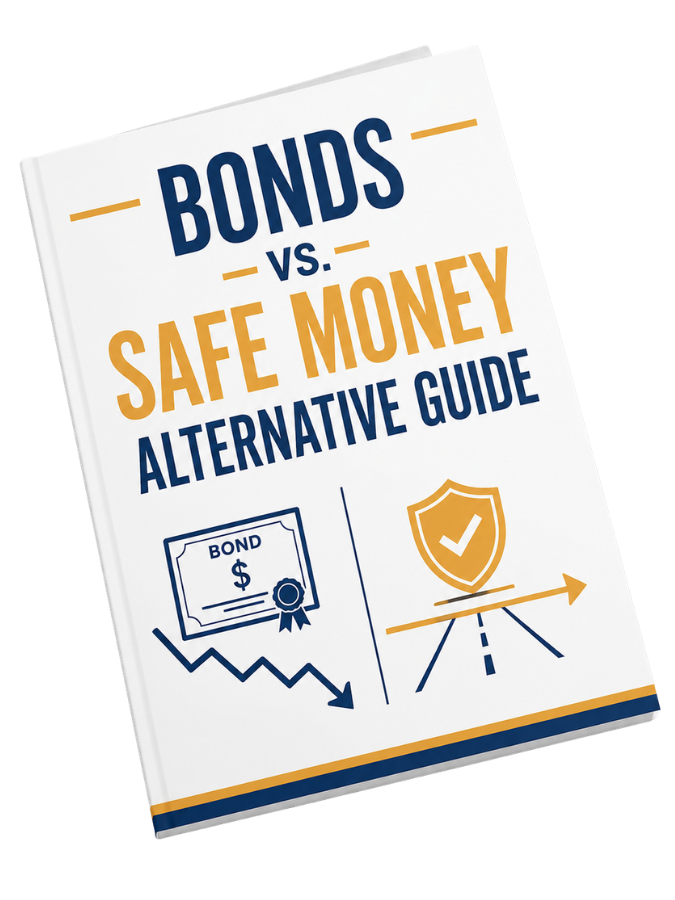
A complete comparison of Bond ETFs vs. the Bond Alternative strategy — with 11 years of real data.
Download Our FREE Guide: Your Safe Money Deserves More
Some advisors invest their clients' retirement income in bond funds, which are different than investing directly into bonds. There is a difference between the two and you can learn more about bond funds on our Annuities vs. Bond Funds page. We've also put together a clear, simple comparison of the top bond ETFs against the Bond Fund Alternative strategy — using 11 years of real market data (2015–2025). You'll see exactly how much the difference in returns and principal protection can mean for your retirement.
No obligation. No sales pitch. Just the data.
Free Booklet