What If Social Security Changes Before You Do?
If you’ve been treating Social Security as a “rock-solid” foundation of your retirement plan, it may be time to reevaluate it.
Here’s why: the United States is carrying a massive national debt—measured in the tens of trillions. To put that into perspective, if someone spent $1,000,000 per day, it would take over 100,000 years to spend $39 trillion.
That big-picture reality matters because debt doesn’t just sit there—it comes with interest. And when interest costs climb, it puts pressure on everything else the government wants to fund.
The Social Security Problem (From Social Security’s Own Projections)
According to Social Security’s own reporting, the retirement trust fund is projected to face a shortfall in the next decade. That doesn’t mean Social Security “disappears.” It means the system may not be able to pay full scheduled benefits without changes.
In plain English: if nothing changes, the program could end up paying less than full benefits based on incoming tax revenue.
If you’re planning to retire in the next 10–15 years, this matters. If you’re younger, it matters even more—because the rules could look very different by the time you need them.
The Main Point You Need to Plan Around
This is the reality most people don’t want to think about, but should:
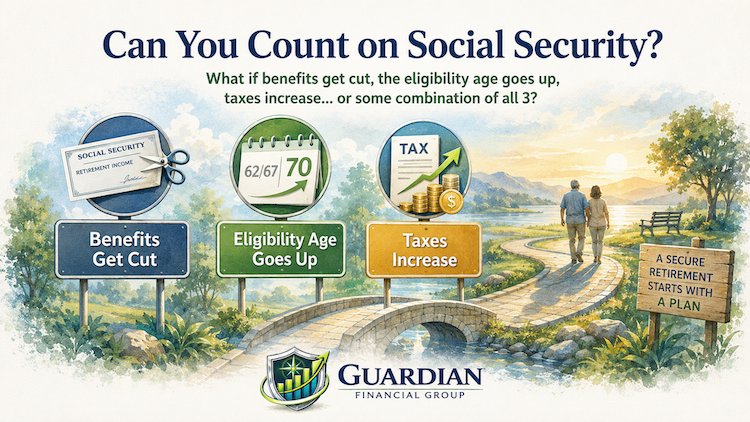
Either benefits get cut, the eligibility age goes up, taxes increase, or some combination of all 3.
That’s the list because there are only so many levers available when a program faces a funding gap:
- Benefits get cut (people receive less)
- Eligibility age goes up (people wait longer)
- Taxes increase (workers and/or employers pay more)
- Or some combination of all three
And here’s the key: you don’t get to vote on which one happens for your household.
A Better Question Than “Will Social Security Be There?”
Instead of asking, “Will Social Security exist?” ask:
How much of my retirement plan depends on Social Security staying the same?
Because if any of these happen—benefits are reduced, eligibility is delayed, or taxes rise—it can change…
- when you can retire
- how much income you’ll need from other sources
- how long your savings must last
- how much risk you may be forced to take later to catch up
What You Can Control: Building Retirement Income You Own
You can’t control what Congress does. But you can control how much of your retirement depends on it.
That’s why many people choose to diversify their retirement income sources with strategies designed to increase control, liquidity, and predictability—especially as they approach retirement.
One Strategy Some People Use: A Properly Structured “Bank On Yourself” Approach
A “Bank On Yourself” strategy (often associated with Infinite Banking) is a way some individuals build a pool of capital using properly structured cash value life insurance.
Depending on the carrier, policy design, and funding strategy, people may use it to:
1) Create more predictability
Certain permanent life insurance policies include contractual guarantees (guarantees are backed by the financial strength of the issuing company). Some policies may also pay dividends, but dividends are not guaranteed, although many companies have. paid them every year for 100+ years even throughout the Great Depression.
2) Access money with flexibility
These types of policies allow access to cash value through withdrawals or policy loans. Used responsibly, this can provide flexibility for:
- unexpected expenses
- income gaps
- opportunities
- planned purchases
3) Potentially reduce future tax uncertainty
Under current tax law, cash value growth is generally tax-deferred and when accessed through a policy loan it’s tax-exempt when structured properly.
This Isn’t “Either/Or”—It’s “How Much Control Do You Want?”
This isn’t about replacing Social Security. For most households, Social Security will likely remain part of the retirement picture.
It’s about avoiding a retirement plan that relies too heavily on a program that may need to change—where the realistic solutions are:
Either benefits get cut, the eligibility age goes up, taxes increase, or some combination of all 3.
A Simple Next Step: Stress-Test Your Retirement
If you’re within 10–15 years of retirement (or even earlier), consider doing a quick “what if” review:
- What if benefits are reduced?
- What if the eligibility age increases?
- What if taxes rise?
- What income sources do I control regardless?
This article is for educational purposes only and does not constitute tax, legal, or investment advice. Individual situations vary, and you should consult with one of our qualified professionals before making financial decisions.