The Infinite Banking Concept (often shortened to IBC) is a cash-flow strategy that uses the cash value inside a properly designed, dividend-paying whole life insurance policy, so you can store money, access liquidity, and finance purchases without relying on traditional banks for every big decision. Done correctly, it’s less about chasing the highest return and more about control, liquidity, and uninterrupted compounding.
Below is a clear, practical breakdown of how it works, based heavily on the “Bank On Yourself” material and supporting guides you uploaded.
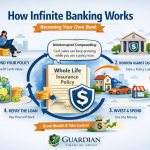
Instead of saving money in a bank and then losing momentum when you spend it, with Infinite Banking you build cash value in a specially structured whole life policy, then borrow against that cash value for purchases—while your cash value can continue growing inside the policy.Step 1: You set up the “bank” (the right kind of whole life policy)
Not every whole life policy is designed for Infinite Banking. The versions used for IBC are typically overfunded (within IRS rules) and use specific riders to accelerate cash value growth—especially early on.
The Infinite Banking “fuel”: base whole life + ridersYour premium is usually structured with two key parts:
- Paid-Up Additions (PUA) rider – often emphasized for faster early cash value growth
- Base premium – tends to drive growth more over the later years as the policy matures
Many designs also use a term rider strategically, because adding death benefit can help you contribute more premium (more PUA) while staying compliant with tax rules and allowing the growth to be accessed tax-free.
Why mutual companies matter (often)Using mutual insurers matters because policyholders are treated like participating owners in the dividend system. Beware of “easy comparisons” like only looking at dividend rates—companies calculate and apply dividends differently.Step 2: You “fuel” the bank by funding premiums (building cash value)
Think of premiums as capital reserves—similar to how a bank needs reserves to lend. Over time, those premiums build cash value inside your policy.
A common mental shift: rather than seeing premiums as “money gone,” Infinite Banking frames properly structured premiums as money repositioned into a system you can later borrow against and recycle.Step 3: When you need money, you take a policy loan (you borrow against cash value)
This is where most confusion (and hype) exists.
You don’t borrow from your cash value.
When you take a policy loan, the money doesn’t come from your policy’s cash value.
- The insurer lends from its general fund.
- Your cash value and death benefit act as collateral for the loan.
That detail matters because it helps explain why many properly designed policies can keep crediting growth while you have a loan outstanding (uninterrupted compounding).
“Uninterrupted compounding”You’re borrowing against the collateral of your continuously compounding cash value, and the full cash value can keep accruing guaranteed interest/dividends as if it never left, because it didn’t leave.
Step 4: You choose your payback schedule (more flexible than most loans)
- Borrow when you want
- Set your own repayment pace and terms
- Pay back monthly, quarterly, lump sum—your choice
Step 5: The “bank” pays you in two main ways: guarantees + potential dividends
A participating whole life policy typically has:
- Guaranteed values (contractual growth)
- Non-guaranteed dividends (the carriers we work with have paid dividends every year for 100+ years)
The guardrails (this is where people get it wrong)
1) MEC rules (tax treatment can change if overfunded incorrectly). If you put “too much premium too fast” relative to the death benefit, the IRS can classify the policy as a Modified Endowment Contract (MEC), changing how distributions/loans may be taxed. We ensure that our clients’ policies are structured properly fro the beginning.
This is one reason policy design and funding strategy matter so much.
2) Policy design matters more than slogans. We’ve people say that they have an Infinite Banking policy, but what we find in some situations is that those people bought a poorly designed policy (wrong company, wrong riders, wrong structure). The good news is, we can “rescue” their policy and help them get setup with a properly designed one without losing any of the cash value they’ve already built.
3) Commissions can influence designSome agents are paid primarily on base premium, which can incentivize designs that build cash value slower early on. With our client, we minimize the base premium and maximize the PUAs to ensure our clients are having access to the maximum amount of cash value from day one.
4) Don’t fall for “dividend rate shopping”The Starter Guide cautions that comparing dividend rates across companies can be misleading because they’re calculated/applied differently.
We’ve created a short educational video below to help our clients learn how it works.
If you’d like to learn more, make sure to schedule a free consultation with one of our professionals: