
Annuities
Annuities vs. Bond Funds
Is Your “Safe Money” Actually Safe?
For decades, the conventional retirement playbook has been simple: put your growth money in stocks, and park your safe money in bonds or bond funds. It sounds reasonable. But the reality is that bond funds carry real market risk — and most retirees have no idea.
In 2022, the Federal Reserve raised interest rates at the fastest pace in 40 years. The result was catastrophic for bond funds — the very investments supposed to protect your retirement:
- iShares IEF (7–10 Year Treasury) lost –15.16%in a single year
- iShares AGG (Aggregate Bond) lost –13.02%
- iShares LQD (Corporate Bond) lost –17.93%
On a $250,000 safe-money allocation, that’s between $32,000 and $44,000 gone — from the part of your portfolio that was supposed to be safe.
There is a better way to allocate your safe money — one that provides principal protection, market-linked growth potential, and tax-deferred accumulation. It’s called the Bond Alternative strategy, and it’s built around the Fixed Index Annuity.
See How Your Safe Money Compares
| Bond ETF | 2022 Return | Loss on $250K |
|---|---|---|
| IEF (Treasury) | –15.16% | –$37,900 |
| AGG (Aggregate) | –13.02% | –$32,550 |
| LQD (Corporate) | –17.93% | –$44,825 |
| Bond Alternative | 0.00% | $0 lost |
While every bond fund lost double digits, the Bond Alternative strategy earned 0% — principal fully protected.
THE PROBLEM
What Your Adviser May Not Be Telling You
When a financial adviser places your retirement savings into a “60/40 portfolio,” that 60% can often go into bond ETFs or mutual funds — not individual bonds. This distinction is critical and while there are major risks with bond funds, there are also downsides to bonds as well.
Individual bonds mature at par — you get your money back regardless of interest rate movements. Bond funds, on the other hand, have no maturity date. When rates rise, they lose real, permanent value. And unlike the losses on your stock side, you may have to sell those losses to fund retirement income.
This is called Sequence of Returns Risk — and it’s the silent destroyer of retirement plans. Suffering losses early in retirement, while making withdrawals, can permanently damage your long-term income sustainability.
“Safe money has one job: don’t lose. Bond funds have been failing at that job.”
The good news is there’s a better place for your safe-money allocation — one that offers a contractual 0% floor, meaning your principal can never go backward due to market losses.
THE SOLUTION
What Is the Bond Fund Alternative?
The Bond Fund Alternative is a strategy built around the
Here's how it works:
- ✓ Your money is not invested directly in the stock market
- ✓ Interest credited is linked to a market index (like the S&P 500)
- ✓ When the index goes down →you earn 0%, never negative
- ✓ When the index goes up → you earn interest, up to a cap or a par rate
- ✓ Your principal and prior credited interest become your new floor each year
The crediting strategy we use as a benchmark: For example, the S&P 500 price return with a 0% annual floor and a 10% annual cap. In years the S&P 500 falls, you earn nothing — but you lose nothing. In years it rises, you participate up to the 10% cap.
People approaching or already in retirement who want growth potential without direct market risk — especially those who are more concerned about protecting what they've already built than chasing higher returns.
| Year | IEF Bond Fund | Bond Alternative |
|---|---|---|
| 2015 | +1.51% | 0.00% |
| 2016 | +1.01% | +9.54% |
| 2017 | +2.55% | +10.00% |
| 2018 | +0.99% | 0.00% |
| 2019 | +8.03% | +10.00% |
| 2020 | +10.01% | +10.00% |
| 2021 | –3.33% | +10.00% |
| 2022 | –15.16% | 0.00% |
| 2023 | +3.64% | +10.00% |
| 2024 | –0.64% | +10.00% |
| 2025 | +8.11% | +10.00% |
| 11-Yr Avg | +1.30% | +7.14% |
FIA column is illustrative. S&P 500 price return, 0% floor / 10% cap. Past performance does not guarantee future results.
$100K grew to
$100K grew to
CAGR = Compound Annual Growth Rate. Hypothetical $100K invested Jan 2015.
THE DATA
11 Years of Real Numbers
We looked at 11 years of actual market data — 2015 through 2025 — and compared the Bond Fund Alternative strategy against the most commonly held bond ETFs in retirement portfolios.
The results are hard to argue with:
- ✓ The Bond Fund Alternative compounded at +7.14% per year (CAGR) over 11 years
- ✓ The best-performing bond ETF (VCIT) compounded at just +3.5%
- ✓ The most popular bond ETFs (BND/AGG) compounded at only +2.0%
- ✓ The IEF Treasury fund — the most commonly used bond benchmark — compounded at just +1.30%
- ✓ $100,000 in the Bond Fund Alternative grew to $213,462 vs. $115,229 in IEF
- ✓ The Bond Fund Alternative had zero losing years — not in 2018, not in 2022, not ever
This isn't about chasing returns. It's about putting your safe money in a strategy that actually does what safe money is supposed to do: protect your principal and still grow over time.
CAGR stands for Compound Annual Growth Rate — the smoothed rate that reflects what your money actually did, accounting for both gains and losses. It's the most honest measure of long-term performance.
WHY IT WORKS
5 Reasons the Bond Fund Alternative Outperforms Bond Funds
1. Principal Protection — Guaranteed
Your account value can never go below what you put in due to market losses. The 0% floor is a contractual guarantee backed by the insurance carrier's reserves — not a market promise. In 2008 and 2022, Bond Fund Alternative holders lost nothing while bond fund investors lost tens of thousands.
2. Market-Linked Upside Without Market Risk
Unlike bond funds that earn a fixed (and often low) yield, the Bond Fund Alternative credits interest based on index performance. When the S&P 500 rises, you participate up to your cap. Over 11 years (2015–2025), this strategy averaged +7.14% annually — versus just +1.30% for the IEF bond fund.
3. No Sequence of Returns Risk
The greatest threat to a retiree's portfolio is suffering losses early in retirement while making withdrawals. With bond funds, a bad year like 2022 forces you to sell depreciated assets to fund living expenses — permanently reducing your recovery potential. The Bond Alternative's 0% floor eliminates this risk entirely.
4. Tax-Deferred Growth
All growth inside a Fixed Index Annuity accumulates on a tax-deferred basis — meaning you pay no taxes on credited interest until you withdraw. Bond and bond fund investors pay ordinary income tax on interest each year, creating a significant drag on compounding. Over 20+ years, tax deferral can add tens of thousands of dollars to your net balance. To learn more about the tax consequences of bonds, see our "Taxes on Bonds vs. Annuities" page.
5. Guaranteed Lifetime Income Options
Most Fixed Index Annuities offer an optional income rider that provides a guaranteed income stream you cannot outlive — regardless of market performance. This solves the single greatest financial risk in retirement: longevity risk. Bond funds offer no such guarantee and can be depleted entirely.
People within 5–15 years of retirement or already retired who want to protect their safe-money allocation from bond market volatility — without accepting near-zero yields.
over the same 11-year period
Hypothetical illustration. Past performance does not guarantee future results. Actual annuity values vary by carrier and product.
No. Variable annuities invest in subaccounts and carry full market risk — your account CAN lose value. The Bond Alternative does NOT invest in the market. Your principal is protected by contract.
Most products allow penalty-free withdrawals of up to 10% of account value per year. Many carriers also waive surrender charges for qualifying events such as nursing home confinement, terminal illness, or death.
Fixed Index Annuities are backed by the carrier's general account and protected by your state's insurance guaranty association (typically up to $250,000 per carrier). Carriers are also required to maintain strict reserve requirements that far exceed those of banks.
Cap rates are set by the carrier and can change at renewal (typically annually). The carrier uses the cost of options on the underlying index to fund the crediting strategy. Your principal is always protected regardless of any cap rate changes.
COMMON QUESTIONS
Who Should Consider the Bond Fund Alternative?
The Bond Fund Alternative strategy is well-suited for retirement savers who:
- ✓ Are within 5–15 years of retirement or already retired
- ✓ Want to protect their safe money from bond market volatility without accepting near-zero yields
- ✓ Are concerned about outliving their retirement savings (longevity risk)
- ✓ Want tax-deferred growth without the complexity and contribution limits of an IRA or 401(k)
- ✓ Experienced the 2022 bond crash and want to ensure it never happens again to their safe-money allocation
- ✓ Are looking for a guaranteed income stream in retirement that cannot be outlived
- ✓ Have a time horizon of 5 years or more (products typically have a surrender period)
A successful retirement isn't measured by how large your portfolio looks — it's measured by whether your income shows up every month, for as long as you live.
The Risks That Threaten Retirement Income
Without proper planning, retirees are exposed to several major risks. The Bond Fund Alternative strategy is specifically designed to address each of them. Bonds share some of these risks in addition to many other. You can learn about the risks direct bond investing has on our "8 Bond Risks Retirees Should Know" page.
Longevity Risk
Living longer is a blessing — but it requires income that lasts 20, 30, or more years. The Bond Fund Alternative includes optional guaranteed lifetime income riders that ensure your money never runs out.
Sequence of Returns Risk
Poor market performance early in retirement can permanently damage income sustainability — even if long-term returns look "average." The 0% floor eliminates this risk entirely. Learn more about Sequence of Returns Risk →
Withdrawal Rate Risk
Traditional rules of thumb — like the "4% rule" — don't adapt well to changing markets, rising inflation, or individual spending needs. A Bond Fund Alternative strategy provides a predictable base of growth to draw from.
Bond Fund Market Risk
The 2022 bond market crash proved that "safe money" in bond funds is anything but safe when rates rise sharply. With a contractual 0% floor, the Bond Fund Alternative means market downturns never reduce your account value.
The Bond Fund Alternative:
Your Safe-Money Strategy
2015–2025
In 11 Years
On $100K
Guaranteed
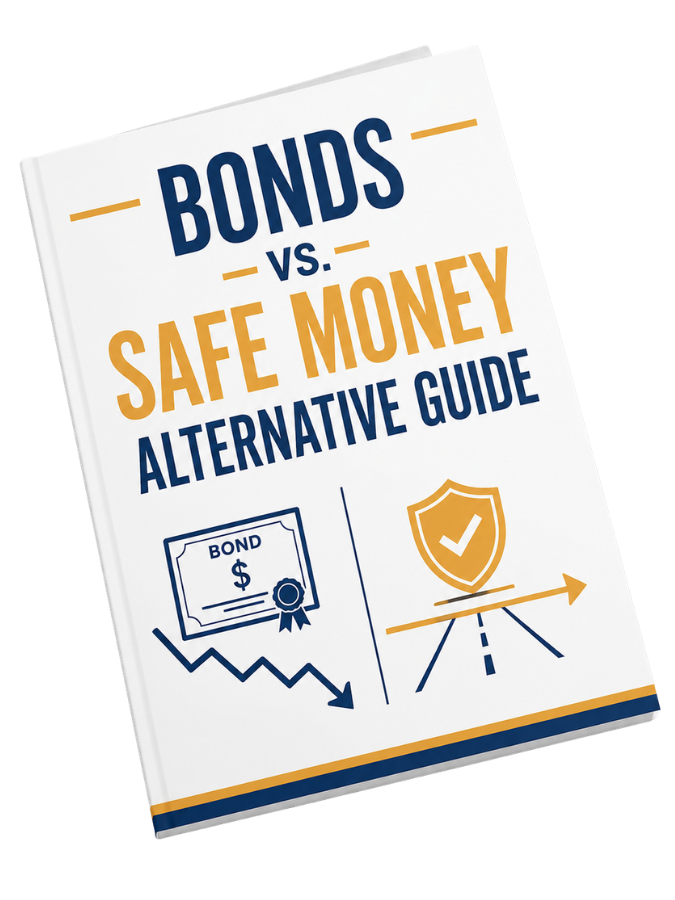
A complete comparison of Bond ETFs vs. the Bond Alternative strategy — with 11 years of real data.
Download Our FREE Guide: Your Safe Money Deserves More
We've put together a clear, simple comparison of the top bond ETFs against the Bond Fund Alternative strategy — using 11 years of real market data (2015–2025). You'll see exactly how much the difference in returns and principal protection can mean for your retirement.
No obligation. No sales pitch. Just the data.
Free Booklet